Italiano
  English
  Português
 Rome and Alba Longa go to war and deploy their armies along the Via Appia Antica, the border between their territories. Over the years Rome and Alba Longa had created a strong bond between them, so much so that numerous families from the two cities were united by marriage ties.
The rulers, in order to avoid bloodshed, decide to entrust the outcome of the battle to three fighters on each side, who would face each other with swords. Rome chooses the Horatii, three brothers sons of Publius Horatius, while Alba Longa fields the three twin brothers, the Curiatii. Complicating everything are the family ties: one of the Horatii was married to Sabina, a sister of the Curiatii, and Camilla, promised bride of one of the Curiatii, was sister of the Horatii.
At the end of the clash, in any case, both women would have suffered a loss in the family: either mourning the husband/fiancé or mourning the brother. The women therefore tried in every way to avoid the fight, but in vain. In the combat two Horatii are killed almost immediately, while two of the Curiatii are only wounded; the only Horatius left alive resorts to cunning to avoid facing three rivals at the same time. He flees toward Rome but is pursued by the Curiatii, who have different speeds and become scattered. The first of the Curiatii to catch him, the only uninjured one, dies from a sword blow. He is then reached by the two wounded Curiatii and prevails over them as well. Rome wins and Alba Longa submits.
The only surviving Horatius demands that his sister Camilla also take part in the success, despite having lost her future husband, but when she refuses he accuses her of mourning an enemy of Rome and runs her through with his sword.

Maybe you might be interested
i dipinti più famosi di Jacques-Louis David
Ecco alcuni dei quadri che forse avrai visto del pittore nato a Parigi nel 1748 e morto a Bruxelles nel 1825
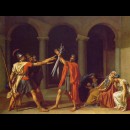
King Louis XVI commissions several works from the painter, and The Oath of the Horatii is one of them, created to celebrate the glorification of loyalty to the State. The painting achieves enormous success and is even defined as the most beautiful painting of the century. The style takes up the classicist manner of the 17th-century French painter Nicolas Poussin. David does not choose to depict a bloody scene, but rather the highest and most solemn moment of the legend, namely the instant in which young fighters, with their oath, confirm their willingness to risk their lives for the glory of Rome.
The men stand with legs apart and tense, one arm stretched forward and determined gazes, while the father is in the act of handing the swords to his sons after receiving the oath "either Rome or death". The scene takes place in an ancient Roman domus, in the cold portico, and on the right side David depicts the women who, aware of the tragedy about to unfold, face fate with inevitable resignation, avoiding theatrical behavior. Sabina and Camilla seek mutual comfort, while the mother of the Horatii, further back, embraces her grandchildren.
The men are described with rigid lines, while the women are instead described with curved lines. David carefully studies the play of light and chooses to leave the background in half-light in order to give as much prominence as possible to the action taking place. The work is preserved at the Louvre Museum in Paris.