 Italiano
  English
  العربية
Bring me to the one who directs the banquet

Giotto reserves the right-hand side of his fresco for him, depicting him almost more like an innkeeper than a butler: as if to underline, with a touch of humor, his familiarity with the convivial arts, he shows him extremely focused on his work but gives him a voluminous belly, supported by a thin belt that contributes to giving him a shape reminiscent of the wine jars beneath; the goblet from which he drinks is always of fine workmanship, like the tableware and dishes placed before Mary and the bridegroom, further signaling the prestige that will inevitably follow from the excellent judgment he will give of the wine. In this sense, his stern gaze can also be understood, in the act of passing from suspicion to wonder.

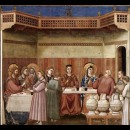
le nozze di Cana nella cappella degli Scrovegni
Rappresentando il primo miracolo di Gesù, Giotto risponde al bizantinismo, proponendo una visione non contemplativa ma drammatica ed umana
Often, however, the figure of the master of the table does not appear. When present, he is recognizable by some distinctive element of his clothing or by his position of prestige at the table.
In Veronese's Venetian canvas, the master of the table is recognizable by the dagger and the satchel hanging from his belt, as he approaches the bridegroom's table addressing him, in the curious gesture of lifting a fold of his green garment. He is standing and shown in profile; the turban and the exotic cut of the fabrics remind the observer that the original scene takes place in the East, but it is perhaps more likely that only at a Venetian banquet of the time could one find all those varieties also present in the painting.
Not to be confused with the master of the table, in Veronese's work there is one who appears in every respect to be a sommelier in the contemporary sense. In this case as well, the author's virtuosity soars very high: the white garment is decorated with tulips, symbols associated with weddings, as is the gold ring with a diamond that sparkles on the finger of the hand holding a brimming goblet, in a posture that combines both the gesture of one who observes the color of the wine before tasting it and that of a priest during Mass. Moreover, the character is not a product of Veronese's imagination, but is in all likelihood a portrait of Pietro Aretino, a Tuscan poet particularly famous at the time the painting was made, and among other things the author of a rich paraphrase of the Cana narrative.
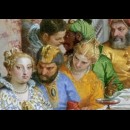
Le nozze di Cana - Il Veronese
la scena religiosa, narrata nel Vangelo di san Giovanni, racconta di un matrimonio che ci svolge nella città di Cana in Galilea. Quando il vino è te...
Pietro l’Aretino che nacque sodomita
Pietro Aretino era dotato di intelligenza e di sagacia, in pochi anni riesce a distinguersi nella vita letteraria e mondana di Roma, nella quale è in...