Italiano
  English
  中國人
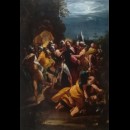
中國人 The action causes the figures portrayed to push against one another. Jesus, the main subject, is not placed at the center because he is being moved from right to left. At the edge of the crowd, a man holds a lantern to counter the darkness. It is Michelangelo Merisi (Caravaggio) behind the soldiers. He is 31 years old, clearly illuminated, and present as an eyewitness. He wants to move forward, pass the soldiers, and observe more closely.
While the painter observes the arrest, Jesus, with his hands clasped in prayer, surrendered and submissive, seems almost to lose his balance. On the other side, John cries out loudly at the moment of the capture.

The Son of God is betrayed with a kiss. Confusion and agitation narrate the God of heaven arrested by earthly orders. Taken from the New Testament, the episode takes place in the Garden of Gethsemane and is present in all four Gospels. The scene is violent: Judas attempts to kiss Jesus in the darkness, which carries a theological meaning. In the Gospel of John, it is in fact said that it was night.
In the eyes of experts, a faint outline of a second ear on Judas demonstrates that the head was originally positioned higher. The armor of one of the soldiers is brightly illuminated thanks to the reflection of light, in a chiaroscuro effect typical of Caravaggio. For this commission, the painter received 125 scudi from the Mattei family, and the painting turned out to be one of the most expensive works of its time. Gradually it was forgotten, only to be rediscovered centuries later in Dublin.
Maybe you might be interested

Il Sacrificio di Isacco di Caravaggio
E' ispirato ad un episodio dell'Antico Testamento in cui Dio sottopone Abramo ha una straordinaria prova di obbedienza. Abramo dovrà sacrificare il suo unico figlio Isacco come prova di fede
THE INCREDIBLE JOURNEY OF THE PAINTING AND ITS REDISCOVERY (PART I)
In 1793 an inventory of the Mattei family's properties was made. It reports that the painting was the work of the Dutch artist Gerard van Honthorst. At that time he was highly sought after, and we do not know whether the mistaken attribution was the result of an error or a deliberate choice by the owners to increase its value. Over time, the work disappeared from the collection and its traces were lost until it was discovered in 1990 in Dublin.
A restorer named Sergio Benedetti, transferred to Ireland, went to the Jesuit residence to restore several paintings. He realized that the work was not by van Honthorst and wanted to understand how it had ended up there. His research lasted three years and demonstrated that the painting had traveled through parts of Europe. Starting from the Vatican archives in Rome, Benedetti discovered that in 1802 the Mattei family was burdened by taxes. They had sold six paintings, among them "The Capture of Christ," almost certainly attributed at the time to van Honthorst. It was officially sold for 150 scudi, but it is assumed that the amount paid was at least four times that.
The new owner was a wealthy Englishman who came to Rome to purchase artworks. He had the paintings brought to his estate in Scotland and placed a plaque on the painting bearing the name Gerard van Honthorst. Generations passed until, in 1921, the line of succession ended. Some paintings were donated to the museum in Scotland, which could choose from a selection. Caravaggio was not among them.
On April 16, 1921, the painting went to auction in Edinburgh; in the catalogue it was not attributed to van Honthorst but described as a copy of his work. It was sold for 30 pieces of silver, about 8 guineas. The buyer was an art dealer who, ironically, held a masterpiece in his hands without knowing it. He in turn sold it to an unknown buyer, and the records offer no help. The Scottish trail came to an end.
THE INCREDIBLE JOURNEY OF THE PAINTING AND ITS REDISCOVERY (PART II)
The Jesuits do not know how it came into their possession, but a priest who lived there from the 1940s to the mid-1960s did know the story of the painting, which had been donated by a member of the community. She was an Irish woman named Mary Wilson, and this is her story.
At Easter in 1916, some Irish rebels took control of the central post office and other public buildings for a week, then surrendered. They were taken to prison by Captain Percival Lea Wilson, the woman's husband. Four years later he was killed by an IRA sniper. His wife wished to commemorate him with a stained-glass window in their parish. The artist commissioned, one of the finest in Ireland, was working in Scotland, so the woman went to visit him. In Scotland she had the opportunity to see Caravaggio's painting in the artist's residence, fell in love with it, and arranged to purchase it.
Mary Wilson returned to Dublin, rebuilt her life, and established a strong bond with a Jesuit priest who lived in the same residence where restorer Sergio Benedetti worked. The priest became mentor and confessor to Mary Lea Wilson, who donated the painting—still believed to be by van Honthorst—to him. It remained there for decades until Sergio Benedetti made his discovery. The priests decided not to sell it and instead placed it on permanent loan to the National Gallery of Ireland.